

Why family budgets fail
Most family budgets do not collapse because the math is impossible. They collapse because the routine around the math asks for too much time, too many decisions, or too much energy at exactly the wrong moment.
The Behavioural Insights Team's EAST framework centers on making actions easier, which is a helpful lens for family budgeting too. If the routine is too annoying to repeat, it usually does not survive school runs, packed calendars, and tired evenings.
That is why a family budget routine has to be:
- simple enough to repeat
- short enough to fit busy weeks
- flexible enough to handle irregular spending
- clear enough that both adults know what is happening
If you need a simpler way to sort your spending before building the routine itself, household expense categories that make family budgeting easier is a good companion read.
The family budget routine: three levels
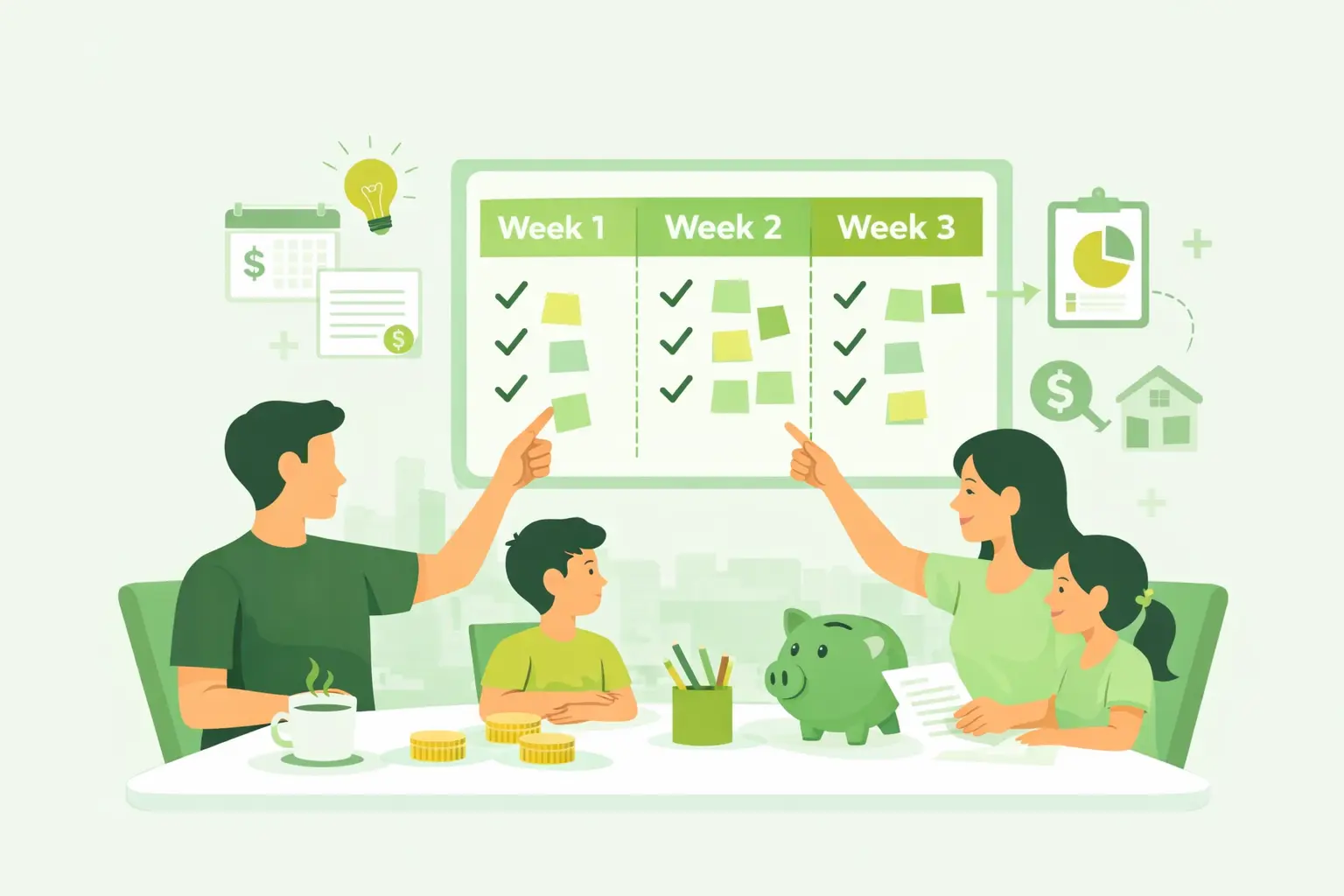
The easiest way to make family budgeting stick is to split it into three layers:
- a monthly reset
- a weekly check-in
- a quick daily habit
Each layer does a different job. Together, they keep the budget from becoming something you only look at after the month has already gone sideways.
Level 1: the monthly reset
Set aside one evening near the start of each month for a simple household money reset.
This does not need to be intense. You do not need a giant spreadsheet or a two-hour summit. You just need a realistic look at what is coming in, what is already committed, and what is likely to need attention this month.
Work through these four steps:
1. Confirm what is actually coming in
Use your real take-home numbers, not salaries on paper.
That means wages, freelance income, support payments, benefits, or anything else your household regularly counts on.
2. List the fixed expenses first
Start with the items that show up every month whether you are ready for them or not:
- rent or mortgage
- utilities
- insurance
- phones
- internet
- transport
- school fees
- subscriptions
- minimum debt payments
Once the fixed costs are visible, you have a much better sense of what the rest of the month has to work with.
3. Estimate the variable categories honestly
This is where families often get too optimistic.
Groceries, fuel, kids' activities, dining out, clothing, and household extras can move around a lot from month to month. The CFPB recommends starting from a realistic view of your spending before setting the budget itself.
Use last month as a reality check, not as a reason to feel guilty.
4. Flag irregular expenses before they hit
This step matters more than most families expect.
School trips, birthday parties, annual renewals, dentist appointments, sports registrations, gifts, and car servicing are not true surprises. They just do not happen every month.
If you want a deeper system for that part, how to budget for irregular expenses before they surprise you goes further into how to handle them.
Level 2: the weekly check-in
This is the part that keeps the monthly plan alive.
Once a week, spend about 15 minutes checking three things:
Review the last week's spending
Open your banking app or expense tracker and scan what happened.
You are looking for:
- categories running hot
- charges you forgot about
- spending that feels off
- anything that needs adjusting early
If tracking always turns into a bigger job than it should, how to track expenses without a spreadsheet can help you keep it simpler.
Check where the month stands right now
Do not wait until the end of the month to learn that groceries are already nearly gone or activities cost more than expected.
You do not need perfect category math. You just need enough awareness to notice when something needs attention.
Look one week ahead
A short glance forward catches a lot:
- a birthday dinner
- a school event
- a bigger grocery trip
- a refill you know is coming
- a payment due later in the week
James Clear's habit stacking approach is useful here. If you attach the check-in to an existing Sunday routine, it is much more likely to become normal.
Level 3: the daily 60-second habit
The daily habit is simple: log spending close to when it happens.
Not because every small purchase is morally important. Because family budgets get blurry fast when nobody remembers what already went out.
The habit can be as simple as:
- logging expenses in a budgeting app
- adding them to a notes app
- using a shared spending category tracker
- checking the bank app and updating a running total
The goal is not perfect bookkeeping. The goal is reducing the gap between spending and awareness.
The part that usually breaks family budgets: irregular expenses
Irregular expenses are where many family budgets quietly fall apart.
These are the things that do not happen every week, but definitely happen:
- school supplies
- uniforms
- activities and club fees
- gifts
- seasonal costs
- home maintenance
- car servicing
One of the most useful ways to handle them is with sinking funds. NerdWallet explains that a sinking fund is money you set aside gradually for a specific future expense, which makes larger costs much easier to absorb without panic.
Here is what a simple family setup could look like:
| Sinking Fund | Monthly Contribution | Purpose |
|---|---|---|
| School costs | $40 | Trips, supplies, uniforms |
| Kids' activities | $50 | Sports, clubs, lessons |
| Christmas and birthdays | $80 | Gifts, celebrations |
| Car maintenance | $60 | Service, repairs, registration |
| Family trips | $100 | Short breaks or annual holiday |
If your family is still trying to build more breathing room overall, how to build an emergency fund when money is tight is worth reading alongside this routine.
When partners handle money differently
Money conversations get harder when one person wants close tracking and the other wants less friction, or when one person feels more anxious about spending than the other.
That is normal.
A few things usually help:
Give each adult some personal spending room
A small no-questions-asked amount can remove a surprising amount of tension.
It means not every coffee, hobby purchase, or small personal spend has to become a shared negotiation.
Split responsibilities by strength
One person may be better at looking ahead. The other may be better at tracking numbers or noticing patterns.
Shared ownership does not have to mean identical tasks.
Talk about goals, not just transactions
Conversations usually go better when they start from a shared reason:
- less stress
- more savings
- a family trip
- fewer end-of-month surprises
Fidelity's guidance on couples and money emphasizes that clearer communication around finances tends to reduce misunderstandings and help couples feel more aligned.
Your family budget routine at a glance
| Rhythm | Time Required | What You Do |
|---|---|---|
| Monthly reset | 60 minutes | Set the budget, review fixed and variable costs, flag irregular expenses |
| Weekly check-in | 15 minutes | Review spending, compare to the month so far, look ahead |
| Daily habit | 60 seconds | Log spending or update your tracker close to the moment |
| Ongoing | As needed | Contribute to sinking funds and adjust as family life changes |
Frequently asked questions
How do we start family budget if we have never budgeted as a family before?
Start with one month of observation. Track what actually comes in and what actually goes out before trying to optimize everything. A realistic budget is much easier to keep than an idealized one.
What should be included in a family budget?
A family budget should include your family's take-home income, fixed bills, groceries, transport, school or childcare costs, debt payments, savings, irregular expenses, and a realistic amount for flexible spending. The goal is not to track every tiny purchase perfectly. It is to make sure the major parts of family life already have a place before the month starts filling up on its own.
How do we involve kids in the family budget?
Keep it age-appropriate and practical. MoneyHelper says money habits start forming early, so letting children see simple budgeting choices, saving for something specific, or talking about needs versus wants can help them learn without turning them into mini accountants.
What is the most important part of family budget routine to start with?
The monthly reset. One clear look at income, bills, variable spending, and irregular costs will already put your family in a better position than trying to budget only after something has gone wrong.
The routine is the point
Most families do not need a more impressive budget. They need a more repeatable one.
A routine creates awareness. Awareness makes better decisions easier. Better decisions repeated over time create stability.
You do not need to do everything in this article at once.
Start with one monthly reset. Then add the weekly check-in. Then make spending awareness a little easier than it is now.
That is usually how a family budget starts working for real.
And if you want a calmer way to stay close to family spending as it happens, download BudgetEase on the App Store.