

Why most people quit spreadsheet budgeting and it is not laziness
Before we get into alternatives, let's be clear about something. If your spreadsheet budget did not stick, it was not a willpower problem. It was a friction problem.
Habit-formation research shows that context stability helps behaviors become more automatic over time, which is exactly why high-friction systems are harder to sustain in real life. Spreadsheet budgeting has a lot of friction baked in:
- You have to remember to update it
- You have to open a laptop or navigate to a file
- You have to remember what you spent and when
- You have to maintain the formulas when something breaks
- You have to actually enjoy spreadsheets on some level
For people who use spreadsheets all day at work, this might feel like second nature. For everyone else, it is just another chore, and chores get skipped.
The goal is not to find more discipline. The goal is to find a tracking method with so little friction that you barely notice you are doing it.
6 ways to track expenses without a spreadsheet
1. Use a dedicated budgeting app
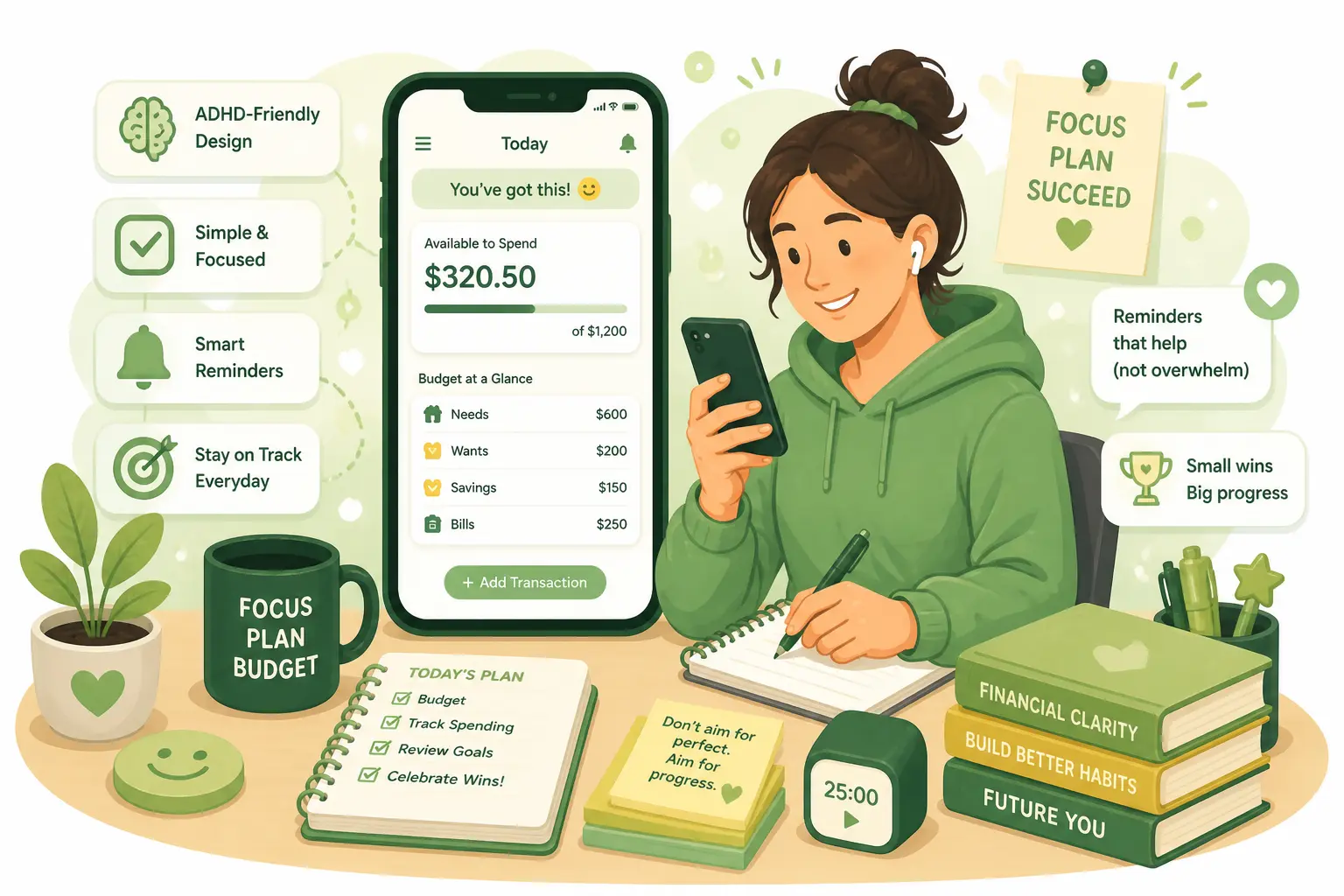
This is the most effective replacement for a spreadsheet. A good budgeting app lives on your phone, takes seconds to update, and gives you visual summaries that make your spending patterns immediately obvious.
The key difference from a spreadsheet is that the app does the heavy lifting. You just log what you spent, and everything else, totals, categories, trends, and progress toward goals, happens automatically.
When looking for an expense tracking app, prioritize these features:
| Feature | Why It Matters |
|---|---|
| Quick expense entry | Logging a purchase should take under 10 seconds |
| Spending categories | Automatically sorts expenses so you can see patterns |
| Monthly summaries | Shows where your money actually went |
| Goal tracking | Connects daily spending to bigger financial goals |
| Mobile access | Your tracker needs to be with you when you spend |
BudgetEase was built around exactly this philosophy: minimal friction, maximum clarity. You open the app, log what you spent, and within a week you have a clearer picture of your finances than you ever got from a spreadsheet.
Download BudgetEase on the App Store
2. Try the envelope method
One of the oldest personal finance tricks in the book still works beautifully for certain people.
The idea is simple. At the start of each month, you withdraw cash for each spending category and put it in a physical envelope, one for groceries, one for entertainment, one for eating out, and so on. When an envelope is empty, that category is done for the month. No app, no spreadsheet, and no extra tracking required.
The envelope method works because it makes spending tangible. Handing over physical cash feels different from tapping a card, and that psychological friction is actually useful here.
Best for people who overspend on cards and want a more tactile approach to budgeting.
The limitation is that it does not work well for online purchases or subscriptions. Most people end up using a hybrid approach, cash envelopes for variable spending and an app for everything else.
3. Use the notes app on your phone
This one sounds almost too simple, and that is the point.
Open the notes app on your phone. Create a new note titled with the current month. Every time you spend money, add it to the list: date, amount, and what it was. That is it.
No categories, no formulas, and no setup time. Just a running log of what you spent.
At the end of the week, take five minutes to add up the totals. At the end of the month, review the list and look for patterns.
This method is best for absolute beginners who feel overwhelmed by budgeting tools and just need to start somewhere. It is not powerful, but it is better than nothing, and it builds the habit of awareness.
Once you are consistently logging expenses, you will quickly hit the ceiling of what a notes list can tell you. That is the natural moment to switch to a proper budgeting app like BudgetEase.
4. Review your bank and credit card statements
You are already spending money, and your bank is already tracking it. The question is whether you are looking at what it records.
The CFPB recommends reviewing your checking account and credit card history to understand your spending patterns, and notes that your bank or credit union may also offer personal financial management tools to help with that process.
Setting aside 10 minutes every Sunday to review your bank app is a genuinely underrated expense tracking habit. You are not doing extra work. You are simply looking at what is already being recorded.
This is best for people who want a low-effort starting point using tools they already have.
The limitation is that bank categorization is not always accurate, and it only covers card transactions. Cash spending still goes untracked. It also does not connect to a budget or savings goal, which limits how actionable the insights are.
5. Do a weekly receipt review
If you prefer a once-a-week approach rather than daily logging, this method works well.
Keep a small pouch, pocket, or screenshot folder throughout the week. Every Sunday, sit down for 15 minutes and go through everything. Add up what you spent, sort it into categories, and compare it to what you planned.
It is a slightly delayed version of real-time tracking, but for people who find daily logging overwhelming, the weekly rhythm can feel much more sustainable.
Research on habit formation suggests that anchoring a new behavior to an existing routine, like a Sunday morning coffee, dramatically increases the chance of sticking with it. Make your weekly money review a ritual, not a chore.
6. Use the 50/30/20 rule
If the idea of tracking every individual expense feels exhausting, the 50/30/20 rule offers a useful alternative: track by percentage instead of by transaction.
Here is how it works:
| Category | Percentage | What It Covers |
|---|---|---|
| Needs | 50% | Rent, groceries, bills, transport |
| Wants | 30% | Dining out, entertainment, subscriptions |
| Savings and Debt | 20% | Emergency fund, savings goals, debt repayment |
Instead of logging every coffee and grocery run, you simply make sure your spending roughly lands within these three buckets each month. It is a broader approach to budgeting, less precise, but often more sustainable for people who find detailed tracking overwhelming.
BudgetEase supports this kind of flexible planning too, especially if you want a simple visual way to compare your spending against clear category limits.
How to actually stick with expense tracking
Knowing how to track expenses is only half the battle. The real challenge is consistency. Here is what actually works.
Start smaller than you think you should
Do not try to track every single expense from day one. Start with just one category, eating out, for example. Log every restaurant and takeaway purchase for two weeks. Once that feels automatic, add another category.
Small habit stacking beats ambitious systems that collapse under their own weight.
Make it a 60-second habit
The best time to log an expense is immediately after you spend, while you are still at the register or just walked out the door. BudgetEase is designed for exactly this: open the app, tap the amount, pick a category, done.
The longer you wait, the more you forget.
Use visual progress as motivation
One of the most underrated parts of a good budgeting app is the visual feedback. Seeing a progress bar fill toward a savings goal, or watching your eating-out category creep toward its limit, creates a feedback loop that genuinely changes behavior.
Health behavior research consistently treats self-monitoring as a core self-regulation technique, because it makes your current behavior visible and easier to adjust over time.
Do not aim for perfection, aim for awareness
You will forget to log something. You will have a week where everything falls apart. That is fine. The goal of expense tracking is not a perfect record. It is awareness.
Even an imperfect picture of your spending is infinitely more useful than no picture at all.
Review once a week, not once a month
Monthly reviews feel important, but they usually come too late to change anything. A weekly 10-minute check-in lets you course-correct while you still can. If you have already blown half your entertainment budget by Wednesday, you can make different choices for the rest of the week.
If you are building the habit as a family, our guide to the best budgeting app for teens is a helpful companion read.
Spreadsheet vs. app: an honest comparison
Spreadsheets are not bad. For some people, especially those who love data and customization, they really are the best tool. But for most people trying to build a consistent money habit, there is a real gap between what spreadsheets promise and what they deliver in practice.
| Spreadsheet | BudgetEase | |
|---|---|---|
| Setup time | 30-60 minutes | Under 5 minutes |
| Daily effort | High, with manual entry and maintenance | Low, with a quick tap to log |
| Always with you | Rarely | Always |
| Visual summaries | Only if you build them | Built in |
| Goal tracking | Manual | Automatic |
| Breaks when you miss a week | Usually | No |
| Best for | Finance enthusiasts who love data | Everyone else |
If you tried a spreadsheet and it did not stick, that is useful information. It means you need a lower-friction system, not more discipline.
Frequently asked questions
What is the easiest way to track expenses?
The easiest method is the one you will actually use consistently. For most people, that means a mobile budgeting app, something you can update in under a minute while you are still standing at the checkout. BudgetEase is designed specifically for that.
How often should I track my expenses?
Ideally, log expenses as they happen. If real-time logging does not fit your style, a short daily recap or a weekly review session are both solid alternatives. The key is consistency, not perfection.
Is it worth tracking every single expense?
In the beginning, yes. Even small purchases add up in surprising ways, and the awareness is the whole point. Over time, as you understand your patterns better, you may find you only need to actively track variable spending while fixed expenses stay predictable.
Can I track expenses for free?
Absolutely. BudgetEase is free to download on iOS and Android. Several bank apps also offer built-in spending summaries at no cost. You do not need to spend money to understand where your money is going.
What is the difference between budgeting and expense tracking?
Expense tracking is the act of recording what you have already spent. Budgeting is the plan you make before you spend, setting limits and goals for each category. The two work best together because your expense tracking informs your budget, and your budget gives your tracking a purpose.
How do I track expenses shared with a partner or family?
For shared expenses, the simplest approach is to designate one person as the tracker for shared spending categories while each person tracks their individual spending separately. A short shared monthly review, even 15 minutes, helps everyone stay aligned without turning one person into the household finance manager.
The bottom line
Expense tracking does not have to be complicated, time-consuming, or dependent on a perfectly maintained spreadsheet. The best system is the one that fits your actual life, and in 2026, that almost certainly means your phone.
Whether you start with the notes app method, try the envelope system, or jump straight into BudgetEase, the most important thing is simply to start. Awareness is the foundation of every good financial decision, and you cannot build awareness without tracking.
Your future self will thank you. Start this week.