

Where the 50/30/20 rule came from
Time notes that the 50/30/20 rule was popularized by Elizabeth Warren and Amelia Warren Tyagi in All Your Worth, which helps explain why so many people know it as a simple way to think about money without tracking every tiny purchase.
That origin matters because the rule was never meant to function like a pass-fail test. It was meant to give people a quick way to check whether their money was roughly balanced across essentials, lifestyle spending, and future progress.
That mindset makes the rule much more useful.
If your numbers do not land perfectly, it does not mean you failed. It means your budget needs to reflect your actual life, not an idealized one.
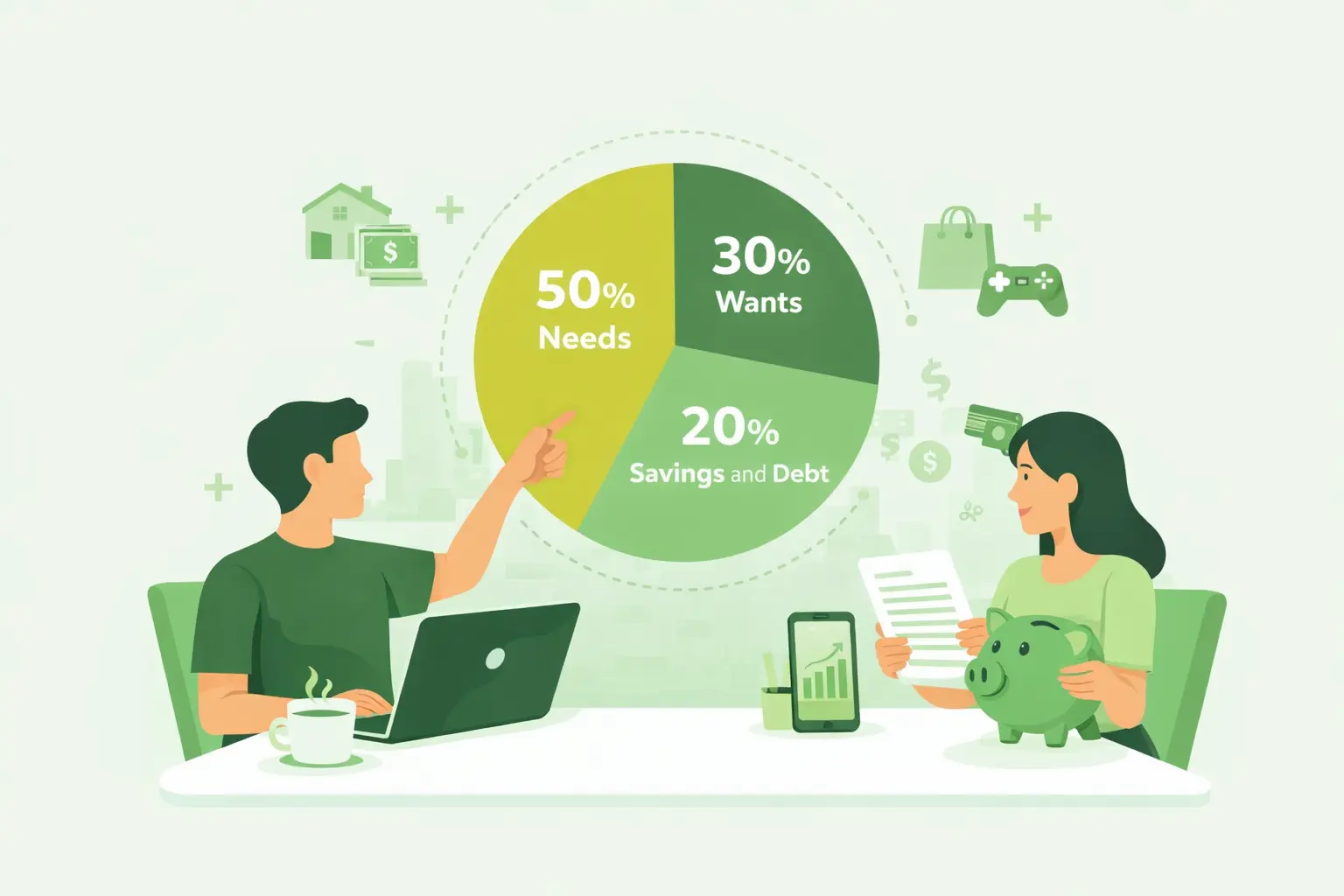
The three buckets explained simply
50% for needs
Needs are the expenses that keep your life running.
That usually includes:
- rent or mortgage
- groceries
- utilities
- phone and internet
- transport
- insurance
- minimum debt payments
- basic household supplies
The tricky part is that a lot of expenses feel important. But important is not always the same thing as essential. Dining out, streaming services, upgraded shopping, and convenience spending usually belong somewhere else.
If stopping the expense for a month would create a real problem, it is probably a need.
30% for wants
Wants are the part of the budget that makes life enjoyable and personal.
That can include:
- dining out
- entertainment
- hobbies
- travel
- shopping beyond the basics
- subscriptions
- social spending
This category is not a mistake in the budget. It is part of the budget.
Giving wants a real place often makes spending feel calmer, because you are deciding on purpose how much room enjoyment gets instead of spending vaguely and feeling guilty afterward.
20% for savings and financial goals
This is the part that supports your future.
That can include:
- emergency fund contributions
- retirement contributions
- extra debt payoff
- short-term savings goals
- investing
If you are still building your first safety cushion, how to build an emergency fund when money is tight is a useful companion read.
The biggest value of the 20% bucket is that it stops savings from becoming an afterthought.
What the 50/30/20 rule looks like with real numbers
Here is what the split looks like at three different take-home pay levels.
Scenario 1: $2,500 monthly take-home
| Category | Percentage | Monthly Amount |
|---|---|---|
| Needs | 50% | $1,250 |
| Wants | 30% | $750 |
| Savings | 20% | $500 |
Reality check: this can feel very tight in a lot of cities. If rent alone is close to $1,000, the needs category fills up fast.
Scenario 2: $3,500 monthly take-home
| Category | Percentage | Monthly Amount |
|---|---|---|
| Needs | 50% | $1,750 |
| Wants | 30% | $1,050 |
| Savings | 20% | $700 |
Reality check: this is often where the rule starts to feel more workable for a single person in a mid-cost area, especially if housing is still reasonable.
Scenario 3: $5,000 monthly take-home
| Category | Percentage | Monthly Amount |
|---|---|---|
| Needs | 50% | $2,500 |
| Wants | 30% | $1,500 |
| Savings | 20% | $1,000 |
Reality check: at this income level, the rule usually becomes more flexible. In a lot of cases, savings can move above 20% if lifestyle inflation does not absorb the difference first.
Four ways the 50/30/20 rule breaks down in real life
1. Needs cost more than 50%
This is the most common problem.
Housing, transport, groceries, insurance, and minimum debt payments can push your needs well past 50%, especially in high-cost cities or lower-income phases of life.
That does not make the framework useless. It just means your first adjustment usually needs to come from the wants category.
Some people temporarily end up closer to:
- 60/20/20
- 55/25/20
- 70/20/10
The point is not defending the original percentages at all costs. The point is making sure the budget still has intentional space for essentials, future progress, and some kind of breathing room.
If your fixed costs are the reason the rule feels impossible, 10 budgeting tips for young professionals who want more control is a helpful next read.
2. Debt changes the math
Minimum payments count as needs, but extra debt payoff usually competes with savings inside the 20% bucket.
That can make the rule feel less straightforward than it first appears.
If you are carrying high-interest debt, it often makes sense to put more of your future-goals money toward paying that down. If your debt is lower-interest and stable, you may choose a more balanced split between saving and repayment.
The point is not forcing one universal answer. It is making the tradeoff visible.
3. Irregular income makes clean percentages harder
The 50/30/20 rule assumes a stable monthly number. Freelance work, commissions, hourly shifts, and inconsistent income can make that hard.
When income changes month to month, it usually helps to build your core budget from the lowest reasonable month, not the average best month. The Consumer Financial Protection Bureau recommends starting with a realistic view of both income and spending before building the budget itself.
That way your essentials are built on something safer, and stronger months can be used more intentionally.
4. Life stage changes the right split
A person just starting out, a couple saving for a home, and a parent managing higher fixed costs may all need different versions of the rule.
That is normal.
Here is a more realistic way to think about it:
| Life stage | Possible adjustment |
|---|---|
| Early career, building first savings | 55% needs / 25% wants / 20% savings |
| Saving for a house or large goal | 45% needs / 20% wants / 35% savings |
| Family with higher fixed costs | 60% needs / 20% wants / 20% savings |
| Higher earner with stable costs | 40% needs / 20% wants / 40% savings |
The best split is not the one that looks neat. It is the one that reflects your actual priorities right now.
A real-life 50/30/20 budget example
Imagine Priya takes home $3,200 a month and wants a budget that feels realistic instead of overly strict.
| Category | Item | Amount |
|---|---|---|
| Needs | Rent | $950 |
| Groceries | $280 | |
| Transport | $110 | |
| Phone | $60 | |
| Utilities | $80 | |
| Insurance | $20 | |
| Student loan minimum | $100 | |
| Needs total | $1,600 | |
| Wants | Dining out and coffee | $220 |
| Streaming | $35 | |
| Gym | $45 | |
| Clothing and personal care | $160 | |
| Entertainment and social | $250 | |
| Travel fund | $150 | |
| Miscellaneous | $100 | |
| Wants total | $960 | |
| Savings | Emergency fund | $250 |
| Retirement contribution | $250 | |
| Short-term goal | $140 | |
| Savings total | $640 |
That budget is not perfect in some abstract way. It is useful because it is intentional, clear, and realistic enough to keep using.
How to start using the rule today
You do not need to rebuild your whole financial life in one sitting.
Start here:
Step 1: Find your real take-home pay
Your budget starts with what actually lands in your account, not with your salary on paper.
Step 2: Audit last month honestly
Go through your bank and card activity and sort spending into needs, wants, and savings. The CFPB encourages reviewing your actual spending patterns before deciding what your budget should look like.
If that part always feels messy, how to track expenses without a spreadsheet can help you simplify it.
Step 3: Fix the biggest gap first
Do not try to fix everything at once.
If needs are too high, start there. If savings are being skipped, start there. If wants are blurry and leaking money, start there.
A framework gets more useful the moment it helps you choose one practical next move.
Frequently asked questions
Is the 50/30/20 rule realistic for low incomes?
It can still be useful, but it often needs adjusting. At lower income levels, essentials can take more than 50% simply because fixed costs do not scale down cleanly. The percentages may change, but the idea of giving your money a deliberate split still helps.
Does the 50/30/20 rule work in expensive cities?
Yes, but often as a modified version. In higher-cost places, people often borrow room from wants first and focus on keeping savings alive even if the split is not perfectly 50/30/20.
Should mortgage payments go under needs?
Yes. Mortgage payments belong in needs, along with other essential housing costs. Fidelity generally recommends keeping housing costs in a range that does not overwhelm the rest of your paycheck, but local housing markets can make that easier or harder in practice.
What if I want to save more than 20%?
That is a good problem to have. Think of 20% as a strong baseline, not a ceiling. If your fixed costs are stable and your income grows, raising the savings percentage can be one of the smartest upgrades you make.
What are the disadvantages of the 50/30/20 rule?
The biggest disadvantage is that it can look simple while still being unrealistic for some situations. High housing costs, debt, irregular income, or a major savings goal can make the percentages feel too rigid. It also does not tell you exactly how to adjust when one category starts crowding out the others, so some people need a more customized version to make it work.
The bottom line
The 50/30/20 rule does not need to fit your life perfectly to be useful.
Its value is not in hitting exact percentages every month. Its value is in giving you a simple way to see whether your money is mostly covering essentials, mostly disappearing into lifestyle spending, or still leaving room for future progress.
If you use it as a flexible framework instead of a rigid formula, it can be one of the easiest ways to make your budget feel clearer.
Simple works best when it is honest.
And if you want a calmer way to stay close to your categories while you test what split works for you, download BudgetEase on the App Store.