
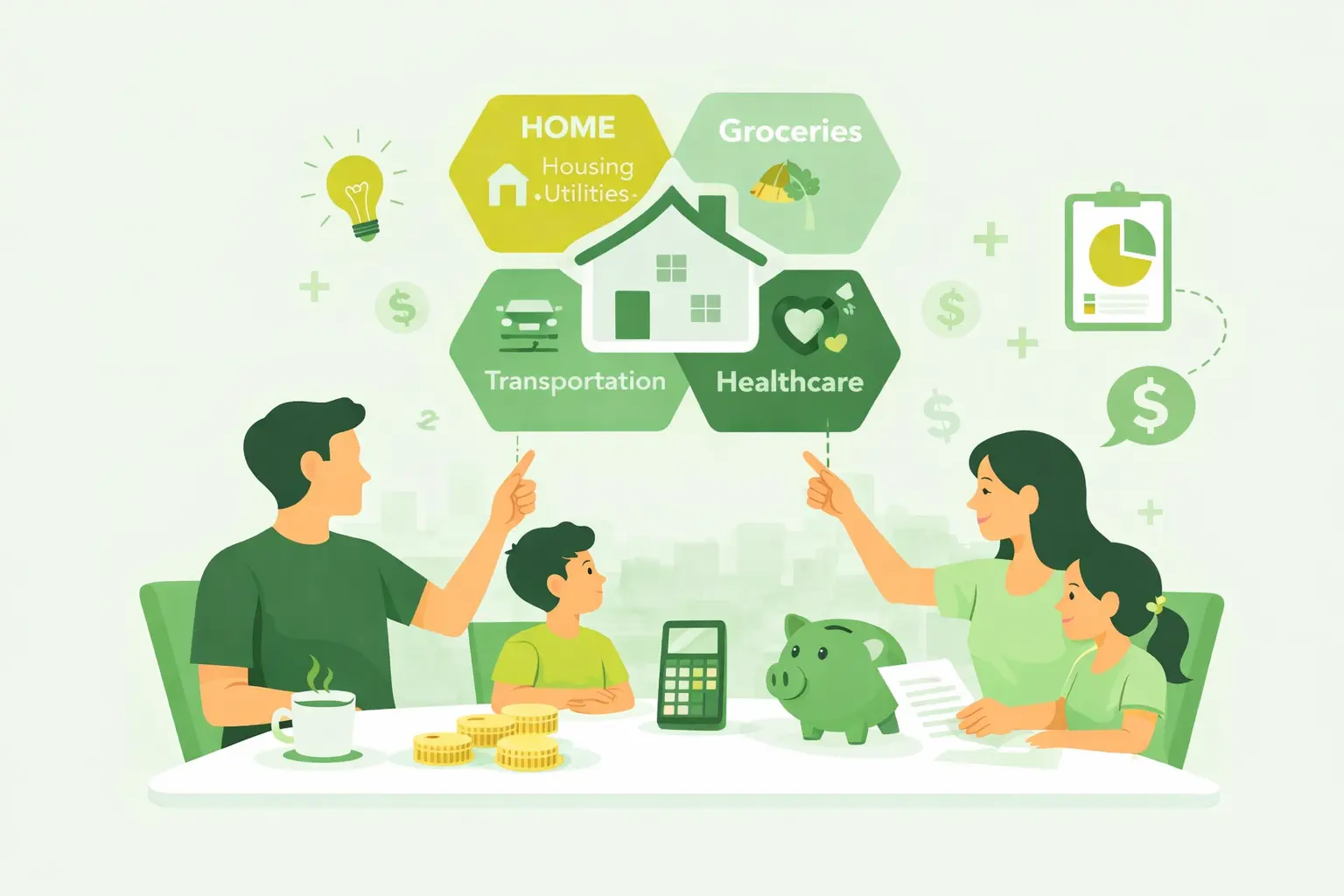
Start with the two main types of household expenses
Before you decide on the categories themselves, it helps to separate household spending into two big types.
Fixed expenses
These are the costs that stay roughly the same each month, such as:
- rent or mortgage
- insurance premiums
- subscriptions
- loan repayments
- some childcare or school fees
These are easier to plan for because they are predictable.
Variable expenses
These are the costs that move around more, such as:
- groceries
- fuel
- activities
- dining out
- clothing
- household extras
These categories usually need the most attention because they are more flexible and easier to underestimate.
The essential household budget categories
Most families do not need dozens of categories. They need the right ones.
1. Housing
This category covers the core cost of keeping a roof over your family's head.
What belongs here:
- rent or mortgage
- property taxes
- home or renters insurance
- HOA or condo fees
- basic home maintenance
Many families aim to keep housing somewhere around one-quarter to one-third of take-home pay when possible, though local housing costs can make that harder. What matters most is understanding how much of the household budget housing is taking before everything else gets squeezed.
2. Food
Food is one of the most important categories to separate clearly because it often hides more than people think.
The easiest split is:
- groceries
- dining out and takeaways
Those are both food-related, but they tell you very different things about your spending.
USDA monthly food cost reports can help you sense-check what home food costs can look like for a reference family, but your real baseline should come from your own receipts and habits.
If you want a better way to keep food and flexible spending visible during the month, a weekly money check-in that takes 10 minutes can help you catch drift much earlier.
3. Transport
Transport often costs more than families realize because it includes both regular and irregular expenses.
What belongs here:
- car payments
- fuel
- insurance
- registration
- parking
- maintenance
- public transit
AAA's 2025 Your Driving Costs analysis estimates that owning and operating a new vehicle costs $11,577 a year on average, which helps show why transport deserves its own category instead of being treated like a small side expense.
4. Utilities and bills
This is the category for the services that keep the house functioning.
What belongs here:
- electricity
- gas
- water
- internet
- mobile phone plans
- trash or waste collection
The Department of Energy's Energy Saver guidance is a useful reminder that utility costs are one of the few regular bills where small behavior changes can still make a visible difference over time.
5. Children and education
If you have children, this category almost always deserves its own space.
What belongs here:
- school supplies
- uniforms
- childcare
- after-school care
- tutoring
- activities and lessons
- school trips
- books and learning materials
Care.com's 2026 Cost of Care report shows just how much childcare can shape a family budget, which is why it helps to keep child-related spending visible instead of hiding it inside general household costs.
6. Healthcare
Healthcare can feel irregular, but the category still matters because it tends to be both important and underestimated.
What belongs here:
- health insurance premiums not already deducted from payroll
- copays
- prescriptions
- dental and vision costs
- over-the-counter medicine
- therapy or mental health costs
KFF's 2023 Employer Health Benefits Survey reported average family health coverage premiums of $23,968 a year, which is a good reminder that health-related costs can be one of the heavier parts of a household budget even before out-of-pocket care enters the picture.
7. Insurance
Some families prefer to keep insurance inside the related category, but many find it easier to track separately.
That can include:
- life insurance
- disability insurance
- pet insurance
- home or car insurance if you do not want them bundled elsewhere
The key is consistency. If insurance is a stand-alone category, keep it that way every month so the patterns stay clear.
8. Debt repayment
Debt deserves its own category when it affects how much room the rest of the budget has.
What belongs here:
- student loans
- personal loans
- credit card minimums
- extra debt payments
The CFPB explains debt-to-income ratio, which is one useful way to see how much of your monthly income is already tied up in debt obligations. If you are putting extra money toward debt, Investopedia's debt avalanche explainer is a useful reference for prioritizing the highest-interest balances first.
9. Savings and financial goals
This category matters because savings should not be whatever is left over if the month went well.
It can include:
- emergency fund
- retirement
- travel
- education savings
- home repair fund
- future family goals
If you are still trying to create that first cushion, how to build an emergency fund when money is tight is a strong next read.
10. Personal and lifestyle
This is the category that keeps the budget realistic and human.
It can include:
- clothing
- haircuts and personal care
- hobbies
- entertainment
- gym or fitness
- gifts
- pet costs
If this category is too vague, it can quietly grow. If it is too restrictive, the budget can start to feel punishing. The goal is enough visibility to make intentional decisions without overcomplicating life.
A practical family budget category overview
| Category | Type | Starting range |
|---|---|---|
| Housing | Mostly fixed | 25–35% of take-home |
| Food | Variable | 10–15% |
| Transport | Mixed | 10–15% |
| Utilities and bills | Mostly fixed | 5–10% |
| Children and education | Variable | 5–15% |
| Healthcare | Variable | 3–8% |
| Insurance | Fixed | 2–5% |
| Debt repayment | Fixed or mixed | based on obligations |
| Savings and goals | Fixed on purpose | 10–20% |
| Personal and lifestyle | Variable | 5–10% |
These are not strict rules. They are starting points that help you notice whether one part of the budget is crowding out everything else.
If you want a simpler high-level framework to compare against, the 50/30/20 budget rule in real life is useful for sense-checking the bigger picture.
How many categories is too many?
A lot of family budgets get harder because people keep adding categories for every small thing.
That usually creates more admin than insight.
A good category should help you make a better decision. If it does not, it probably belongs inside a broader bucket.
For most households, 8 to 12 main categories is enough. That gives you visibility without turning the system into something nobody wants to maintain.
Frequently asked questions
What is the most important budget category for families to get right?
Food is one of the most useful categories to separate clearly, especially the split between groceries and dining out. It is often one of the most flexible parts of the budget and one of the easiest to underestimate.
Should I track every small purchase in its own category?
No. The point of categories is visibility, not perfection. If a category is too tiny to influence a real decision, it usually belongs inside a broader one.
How do I handle expenses that could fit in more than one category?
Pick one place and stay consistent. A category system works best when monthly comparisons stay clean, even if the categories are not philosophically perfect.
How often should I review and update my categories?
Give the system a little time to show you patterns. Three months is usually enough to see whether categories are too broad, too narrow, or missing something important.
The right categories make everything easier
Most families do not need a more complicated budget. They need a clearer one.
The right categories act like a map. Once spending is sorted into buckets that match how your household actually works, the whole system gets easier to trust and easier to adjust.
Start with the essential categories above. Keep them simple. Then keep looking at them regularly.
That is usually where family budgeting starts to feel much more manageable.
And if you want a calmer way to keep those categories visible during the month, download BudgetEase on the App Store.